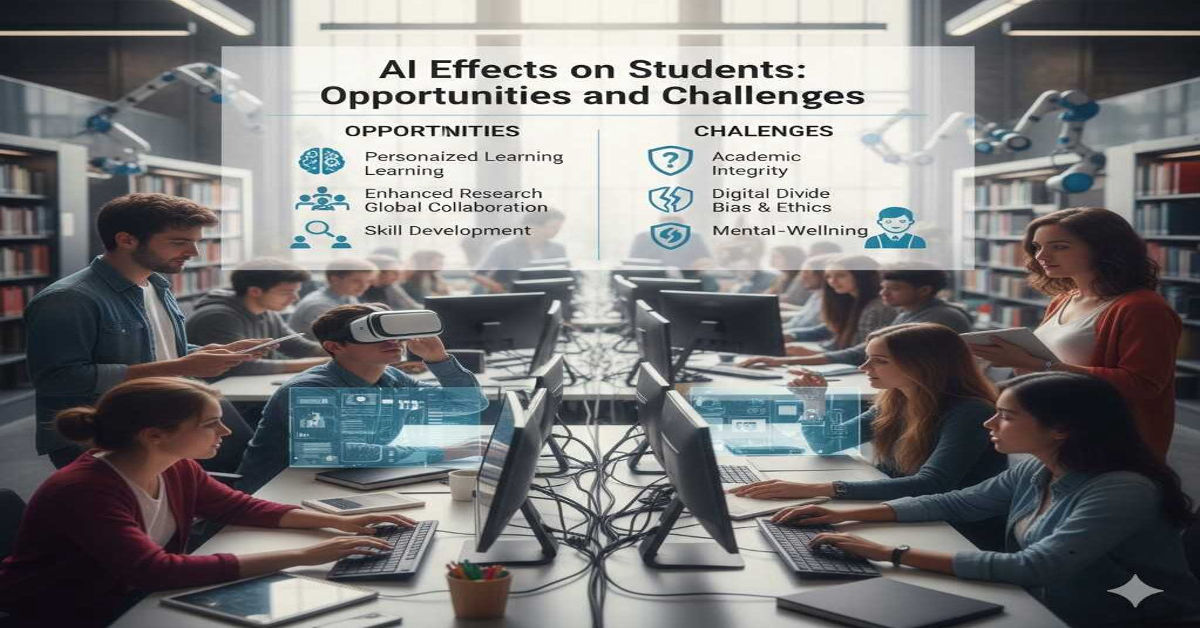
Artificial Intelligence (AI) has become one of the most influential technologies of the 21st century. From smart assistants like ChatGPT to personalized learning apps, AI is transforming how students learn, study, and prepare for the future. In the United States and around the world, schools, colleges, and universities are actively exploring how AI can support education. But AI is not just a powerful tool-it also raises questions about dependency, ethics, and real meaning of learning. This blog explores the effects of AI on students, highlighting both the benefits and the challenges, along with future trends in AI-driven education.
Positive Effects of AI on Students
1.Personalized Learning
One of the biggest advantages of AI in education is personalization. Traditional classrooms follow one teaching pace, but every student learns differently. AI-powered platforms can adapt lessons to a student’s strengths and weaknesses. For example, U.S. tools like Khanmigo (by Khan Academy) use AI to act like a personal tutor, guiding students step by step.
2.Smart Tutoring Systems
AI-based tutoring systems are available 24/7. Unlike human tutors, AI doesn’t get tired. Students can ask questions anytime and receive instant explanations. This helps those who cannot afford private tutors or need extra support outside class hours.
3.Accessibility for All Students
AI tools are improving accessibility in education. For example:
Voice-to-text helps students with hearing difficulties.
Voice-to-speech assists visually impaired students.
Real-time translation supports international students in USA. This inclusivity ensures that AI is not just about efficiency, but also about equal learning opportunities.
4.Research and Time-Saving Tools
Students often spend hours searching for resources. AI can summarize articles, explain complex topics, and even generate practice quizzes. For example, ChatGPT can break down complicated math concepts or summarize a history chapter in simple terms.
Negative Effects of AI On Students
While the benefits are significant, AI also comes with drawbacks that educators, parents, and students must address.
1.Over-Dependence on AI
Students may start depending too much on AI instead of developing their own problem-solving skills. For instance, relying on AI to write essays or solve homework can weaken creativity and independent thinking.
2.Acadmic Dishonesty
AI makes it easier for students to copy assignments or generate entire projects without effort. In the U.S., many universities are now introducing AI detection tools to catch plagiarism and ensure academic integrity.
3.Reduced Critical Thinking
If students simply accept answers from AI without questioning, they may lose the ability to analyze and think deeply. Critical thinking, debate, and reasoning are skills that cannot be replaced by technology.
4.Privacy and Data Risks
AI tools often collect user data. Students study habits, personal information, and even exam answers may be stored on servers. This raises concern about data privacy and security.
Real-Life Examples of AI in U.S. Education
ChatGPT in Classrooms- Many students in the USA use ChatGPT to draft essays, prepare for exams, and practice languages.
Khanmigo (Khan Academy)- An AI tutor integrated into online learning platforms.
Duolingo- Uses AI to personalize language learning for each student.
Gradescope- AI-powered grading system that helps professors evaluate student assignments faster.
These example show that AI is already shaping the student experience in powerful ways.
Future of AI In Education
Looking ahead, AI will continue to influence education in several ways:
Virtual Classrooms With AI mentors -Instead of one teacher for many, each student could have a personal AI mentor.
AI in career Guidance – AI tools may analyze student’s strengths and suggest career paths.
More collaboration – Students may not work on AI-assisted group projects, preparing them for AI-driven workplaces.
Regulations and Balance – U.S. schools will likely create stronger rules to prevent misuse while encouraging responsible learning.
Conclusion
AI is transforming education by making learning more personalized, accessible, and efficient. At same time, it introduces challenges such as over-reliance, academic dishonesty, and data privacy risks. For students, the key is balance: use AI as a learning partner, not as a replacement for efforts and creativity. Teachers and parents should guide students to take advantage of AI responsibly, ensuring that technology enhances learning rather than weakening it. In the coming years, AI will not just be a trend-it will be an essential part of every student’s learning journey. Those who use it wisely will be better prepared for the future.
FAQ :
1. What’s the biggest concern with students using AI for schoolwork?
The most immediate challenge is the temptation to use AI for shortcuts over learning. The main risk isn’t the technology itself, but how it’s used. The biggest concerns are:
Plagiarism and Academic Dishonesty: Submitting AI-generated work as one’s own undermines the entire learning process. It prevents students from developing critical thinking and writing skills.
Surface-Level Understanding: Relying on AI for answers can mean a student never engages deeply with the material, leading to a fragile understanding that cracks under pressure during exams or real-world application.
2.Will AI make critical thinking skills obsolete?
Quite the opposite. AI actually makes critical thinking more important than ever.
With AI handling basic fact-finding and summarization, the value of a student’s education shifts. The future will reward those who can:
Ask the right questions to guide an AI tool effectively.
Analyze and verify the information AI provides (as it can sometimes be biased or incorrect).
Synthesize AI-generated ideas with their own to create novel arguments and solutions.
In essence, AI pushes us from being mere repositories of information to becoming skilled directors, editors, and innovators.
3.How can I tell if my child is using AI responsibly or just cheating?
This is a common worry for parents and teachers. Look for these signs of responsible use:
They can explain their work. If your child can clearly walk you through how they arrived at their answer or the thought process behind their essay, they likely used AI as a helper, not a replacement.
AI is used for drafting, not final copy. Responsible use looks like generating ideas or creating a first draft, which the student then heavily edits, refines, and makes their own.
They cite their sources. Just as we learned to cite books and articles, a new skill is learning to transparently acknowledge when AI was used in the development of their work.
Open conversations about how and why they are using these tools are the best prevention for misuse.